
📌 TL;DR
A moving average strategy for beginners helps you follow the trend, avoid noise, and find better entry points.
By combining trend direction, pullbacks, and confirmation signals, beginner traders can improve their decision-making and reduce emotional trading.
💡 Introduction
A moving average strategy for beginners is one of the simplest ways to follow market trends and improve entry timing.
Many beginner traders learn the concept but still struggle with one key question:
👉 “When should I actually enter a trade?”
This is where a proper moving average strategy becomes essential.
In this guide, you’ll learn a simple and effective moving average strategy
that you can apply immediately in real market conditions.
📊 1. Why You Need a Moving Average Strategy
A moving average alone does not give you a complete trading plan.
If you’re new to moving averages, check out Investopedia’s guide on moving averages for a deeper explanation.
It shows the trend, but it does not tell you:
- When to enter
- When to wait
- When to avoid trades
That’s why you need a structured moving average strategy.
The goal is simple:
👉 Trade with the trend, not against it.
📈 2. The Best Moving Average Strategy (Step-by-Step)
This moving average strategy for beginners is based on three simple steps: trend direction, pullbacks, and confirmation signals.
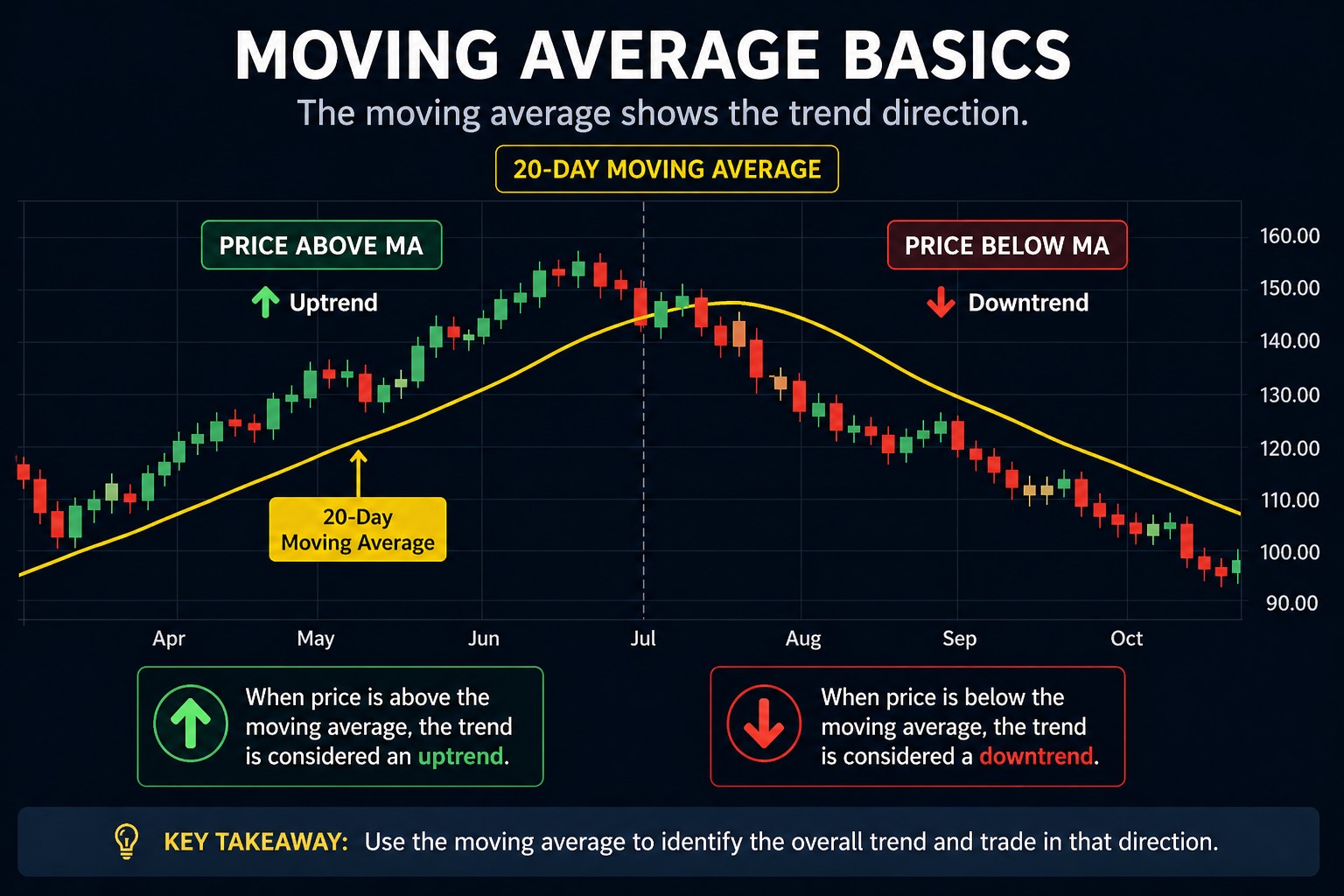
✔ Step 1: Identify the Trend
First, determine the overall trend using a moving average.
- Price above the moving average → uptrend
- Price below the moving average → downtrend
👉 Only trade in the direction of the trend.
This is the most important rule in any moving average strategy.
If you’re new to moving averages, it’s important to understand the basics first.
👉 Moving Average Explained: 3 Key Signals Every Beginner Must Know
✔ Step 2: Wait for a Pullback
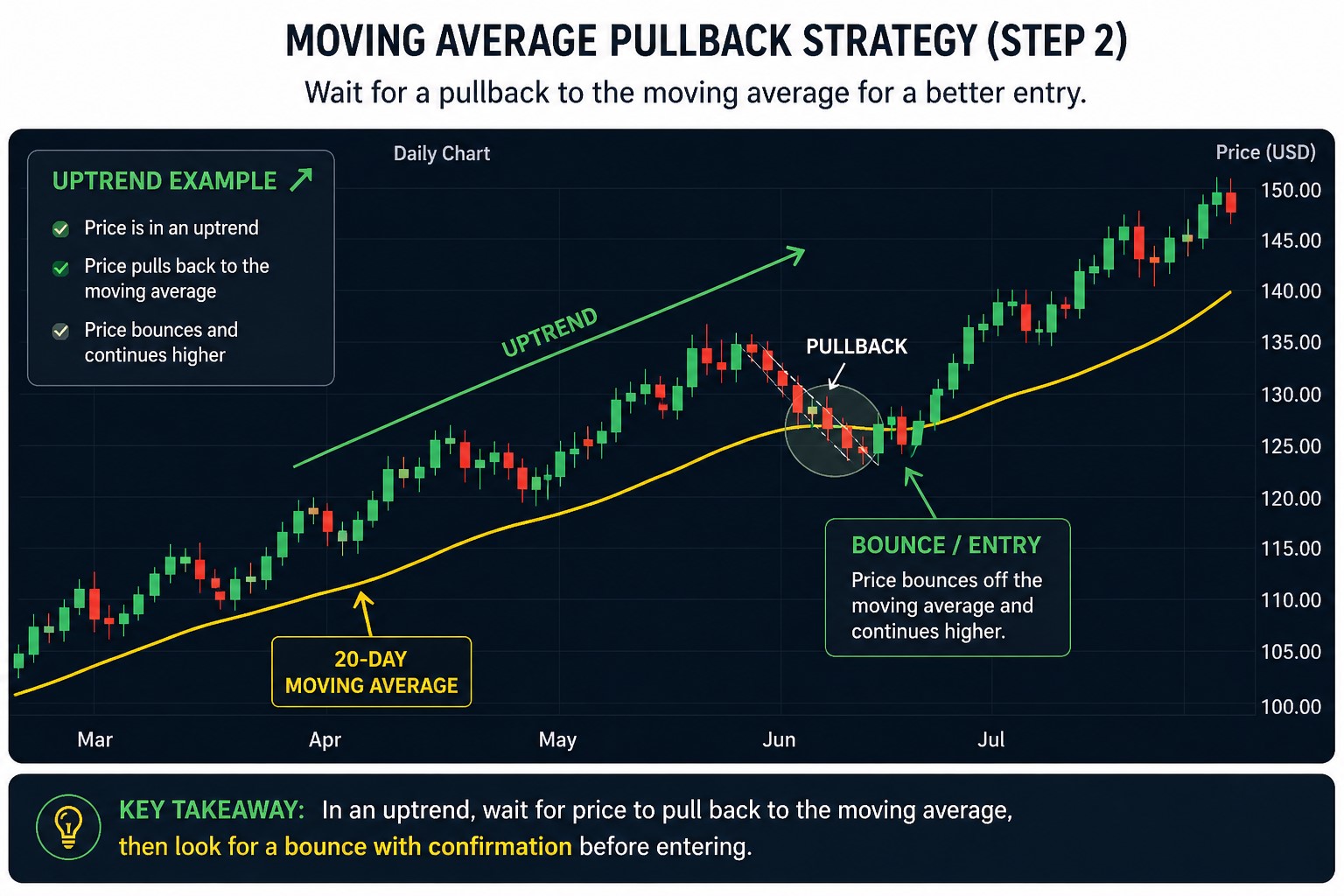
Do not enter immediately.
Instead, wait for price to retrace back toward the moving average.
In an uptrend:
- Price pulls back toward the MA
- Then stabilizes or slows down
In a downtrend:
- Price moves up toward the MA
- Then gets rejected
👉 This pullback creates a better risk-to-reward entry.
This helps filter out weak signals and improve entry accuracy.
✔ Step 3: Look for Confirmation
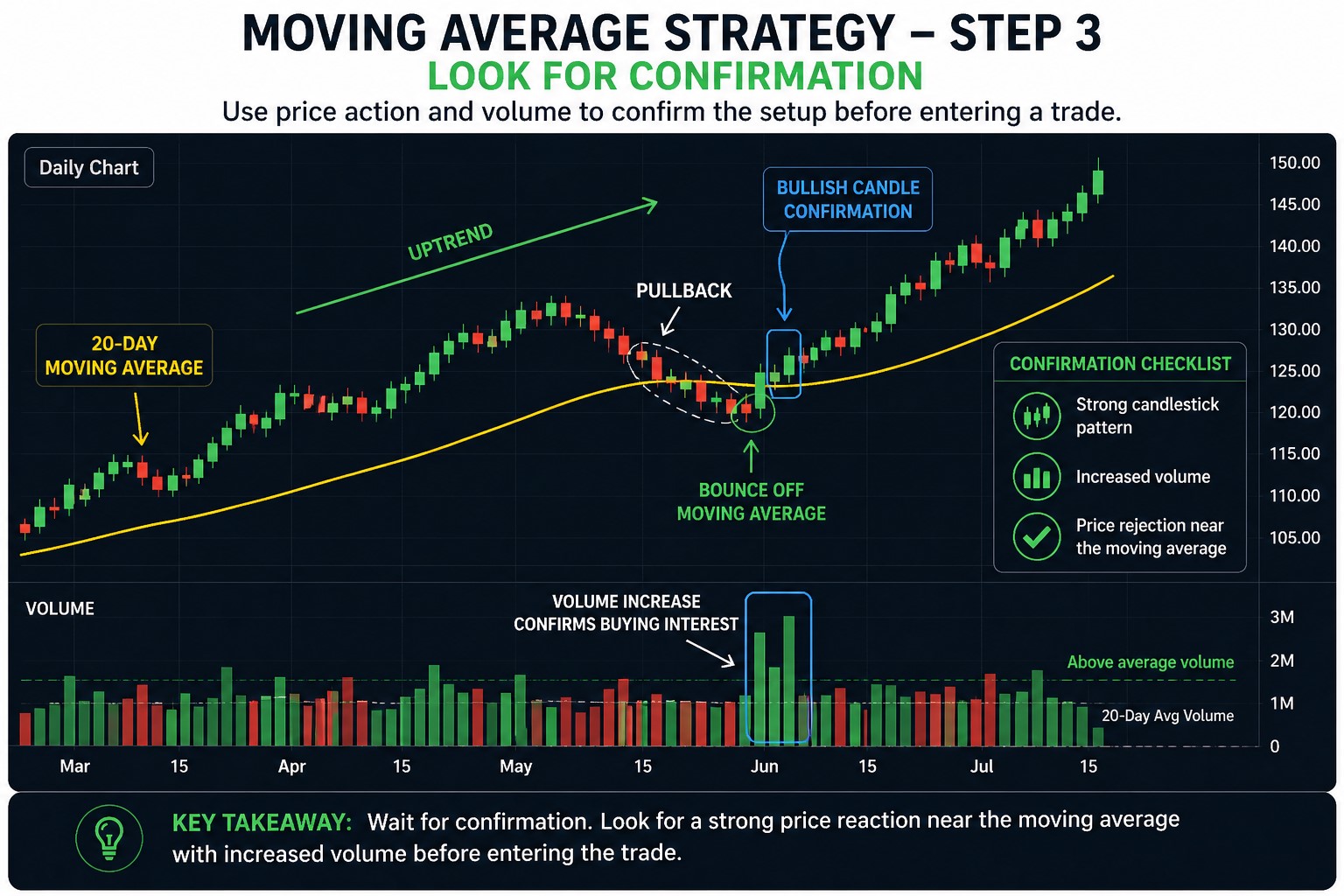
Before entering a trade, wait for confirmation.
This can include:
- Strong candlestick patterns
- Increased volume
- Rejection wicks near the moving average
Volume helps confirm the strength of a trend, as explained in [Investopedia’s guide on volume].
For better confirmation, read:
👉 How to Read Volume in Stock Trading: 3 Key Signals (Beginner Guide)
If you’re not familiar with candlestick patterns, start here:
👉 How to Read Candlestick Charts (Beginner Guide)
🔥 3. Real Trading Example (Simple Scenario)
Let’s say a stock is in an uptrend.
- Price stays above the 20-day moving average
- It pulls back to the moving average
- Volume increases as buyers step in
- A bullish candle forms
👉 This is a high-probability entry point.
Instead of chasing price at the top,
you enter after a pullback with confirmation.
You can practice this strategy using real charts on platforms like [TradingView].
⚠️ 4. Common Beginner Mistakes
Even with a good moving average strategy, many beginners make the same mistakes.
❌ Entering too early
- Not waiting for pullbacks
❌ Trading against the trend
- Trying to catch reversals
❌ Ignoring confirmation
- Entering without volume or price signals
👉 The key is patience.
🧠 5. Simple Rules to Follow
To make this moving average strategy work, keep it simple:
- Always trade with the trend
- Wait for pullbacks, don’t chase price
- Use confirmation before entering
- Avoid overcomplicating your setup
👉 Simple strategies often work best.
A simple moving average strategy for beginners helps reduce emotional trading and improve long-term consistency.
🎯 Final Thoughts
A moving average strategy is one of the most powerful tools for beginner traders.
It helps you stay on the right side of the market
and avoid emotional decisions.
But remember:
👉 The moving average shows direction
👉 Your strategy defines execution
If you combine both,
your trading will become more consistent and structured.
This moving average strategy for beginners is simple, but powerful when used with discipline and patience.
📌 Next Step
Now that you understand how to use a moving average strategy,
the next step is exploring additional tools to improve your trading.
👉 Best Indicators for Beginner Traders (Simple & Practical Guide)
❓ FAQ
Q1. What is the best moving average strategy for beginners?
A simple trend-following strategy using pullbacks and confirmation is the most effective for beginners.
Q2. Which moving average should I use?
The most common are 20-day, 50-day, and 200-day moving averages.
Q3. Can I use this strategy in crypto or forex?
Yes. This moving average strategy works in all markets.
Q4. Is a moving average strategy profitable?
It can be, if combined with proper risk management and discipline.
Q5. Do I need multiple indicators?
No. A moving average strategy works best when kept simple.
🔍 Related Articles
To better understand this topic, it helps to explore related concepts such as:
📈 Trading Basics
⚠️ Disclaimer: This article is for educational purposes only and should not be considered financial advice. Please conduct your own research before making any investment decisions.